
What Happens After Mediation? Understanding the Legal Weight of Your Agreement
You sat across from your spouse. You talked through the hard things. You reached an agreement. Now you need to know: does it actually hold up in court?
It is one of the most common questions people ask before, during, and after divorce mediation. And the answer matters more than most people realize, because it affects your finances, your parenting plan, and your ability to move forward with certainty.
Here is what you need to know about whether divorce mediation is legally binding in Massachusetts, how the process moves from handshake to court order, and which parts of your agreement can be changed down the road.
Mediation Itself Does Not Create a Binding Agreement
This is the part that surprises people.
The mediation sessions themselves are not legally binding. They are negotiations. Conversations. A structured process where both parties work through the terms of their separation with the help of a neutral mediator. Nothing you say or agree to during mediation locks you in automatically.
The binding part comes later.
When mediation is successful, the agreements you reach are documented in a formal Separation Agreement. That document is then filed with the Massachusetts Probate and Family Court as part of a 1A Uncontested Divorce. Once a judge reviews and approves the agreement, it becomes a court order. At that point, it is legally binding and enforceable.
So mediation produces the agreement. The court gives it teeth.
How the Separation Agreement Gets Filed
When Attorney Laura Greco serves as the neutral mediator in a divorce case, she drafts the Separation Agreement along with all of the 1A pleadings required for filing. This means the paperwork that reflects everything you agreed to during mediation is prepared by an thoughtful family law attorney who understands exactly what the court expects to see.
There is an important distinction to understand here. As the neutral mediator, Attorney Greco cannot attend the final hearing or file a Notice of Appearance on behalf of either party. This is standard practice in Massachusetts mediation. The mediator serves both parties equally and does not represent either one individually in court.
That said, both parties are thoroughly prepared in advance for what to expect at the hearing. You will know what the judge will ask, how the process works, and what to bring. There are no surprises.
When Does Divorce Mediation Become Legally Binding in Massachusetts?
The timeline looks like this:
- You and your spouse reach agreement on all terms through mediation.
- The Separation Agreement and 1A pleadings are drafted and reviewed.
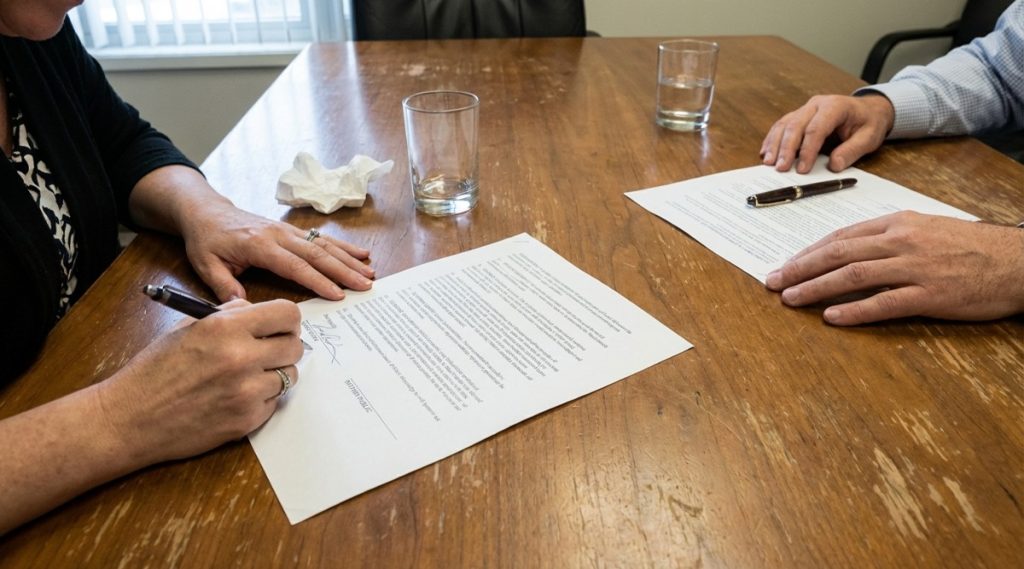
- Both parties sign the agreement.
- The paperwork is filed with the Probate and Family Court.
- A judge reviews and approves the agreement at a brief hearing.
- The judgment enters, and a 120-day nisi period begins.
That 120-day nisi period is specific to Massachusetts. It is essentially a waiting period before the divorce becomes absolute. Think of it as the state’s built-in cooling-off window. Once those 120 days pass, your divorce is final.
The Separation Agreement becomes legally binding when the judge approves it. The nisi period does not change the enforceability of your agreement. It simply delays the moment when your marital status officially changes.
What Can Be Changed Later, and What Cannot
Not everything in a Separation Agreement is set in stone. Massachusetts law recognizes that life changes, and certain provisions can be modified after the divorce is finalized.
Child custody arrangements, child support, and alimony can all be modified if there is a material change in circumstances. A new job. A relocation. A significant shift in income or parenting needs. These are the kinds of changes that may warrant revisiting the original terms through a modification action.
Property division is different. Once the judgment enters, the division of assets and debts is generally final. Courts rarely reopen property settlements, and only under very narrow circumstances like fraud or failure to disclose assets. This is one of the reasons it is so important to get the property terms right during mediation, before the judge signs off.
The takeaway: mediation gives you control over the terms while you still have the chance to shape them. Once property division is locked in, it stays.
Why Mediation Agreements Hold Up So Well in Court
Judges in Massachusetts tend to approve mediated Separation Agreements without issue. There is a reason for that.
When both parties have negotiated their own terms voluntarily, with full disclosure and the guidance of a neutral mediator, the court sees an agreement that reflects genuine consensus. There is no claim that one side was pressured or uninformed. Both parties showed up, did the work, and signed off.
Compare that to a litigated divorce where a judge imposes terms on two people who could not agree. Mediated outcomes tend to be more durable because both parties had a voice in creating them. People are far more likely to follow through on commitments they helped design.
This is one of the core reasons that divorce mediation, once it goes through the court process, produces outcomes that last. The foundation is mutual agreement, not judicial mandate.
Taking the First Step Toward a Binding, Fair Agreement
If you and your spouse are considering mediation, you are already thinking about this the right way. You want resolution. You want fairness. And you want to know that what you agree to will actually be honored.
Mediation gives you all of that. It gives you a structured process, a neutral guide, and a legally enforceable outcome once the court approves your agreement. It is faster, less expensive, and far less adversarial than litigation. And the agreements it produces hold up.
Attorney Laura Greco has guided families throughout the greater Woburn, Massachusetts area through every stage of this process, from the first mediation session to a signed, court-approved Separation Agreement. Her goal is straightforward: help both parties walk away with clarity, confidence, and a divorce mediation agreement that is legally binding in Massachusetts.
Ready to find out if mediation is right for your situation? Schedule a free consultation or call (978) 806-6922 to speak with Attorney Greco directly.